Saturday, February 9, 2013

Duty Calls, Contests Abound

The simple response would have been to ignore an unsolicited email from some faceless blogger and disgruntled weekend handicapping contest player.

However, Tampa Bay Downs steward John Morrissey was courteous enough to respond to my inquiry about a stewards' inquiry in Race 3 last Saturday, which proved an inflection point in my fortunes in the first of three Simulcast Series Challenge contests at Monmouth Park.

Recall that I was baffled by the disqualification of my selection, 18-to-1 Duty Blues, from a second-place finish for what appeared to be a phantom claim of foul by Scott Spieth, the rider of the fourth-place finisher, Shellback.  On its surface, the race replay seems to show the eventual winner, 5-to-2 Thank U Philippe, nudging Duty Blues into Shellback and causing negligible interference.

On track, I and another contest player who had Duty Blues figured the inquiry might have moved our horse UP (to a first-place finish), rather than DOWN (to fourth place), on account of Thank U Philippe causing the contact.

What was not clear to me in watching the replay several times, nor in the Equibase full chart, was that Antonio Gallardo, rider for Duty Blues, made contact with his whip on the head of Thank U Philippe, causing that horse to move in and setting off a chain reaction that the stewards felt cost Shellback third place, since Spieth pulled up Shellback to avoid clipping Duty Blues' heels.  Hence, the D'Q.  

A fellow writer and avid horseplayer whom I respect miraculously noticed this after his review of the replay, noting that Thank U Philippe's head reared back in the stretch, signaling that Gallardo was a bit sloppy with the whip and perhaps the steward were trying to "teach the jockey a lesson" for sloppy riding.  That notion seemed entirely valid and better than anything I had heard to that point in time.

Mr. Morrissey, in an email this week, validated my colleague's observation that Gallardo accidentally stuck Thank U Philippe's head with his whip, though in light of the finish I'm not sure I agree with that rationale of the D'Q and final placing of horses, based on how steward decision.  On the other hand, he admitted that the contact between Thank U Philippe and Duty Blues had no bearing on Shellback. Hmm...

Confused Yet?

In my opinion, and without belaboring the point, Philippe and Duty Blues were clearly the strongest two finishers that race and Shellback clearly tired.  I get the notion that Shellback might have been cost a third-place finish (more purse money than fourth place where he finished, of course), but if anything I would charge that, based on the stewards' explanation, the final order should have been Thank U Philippe (6), Shellback (4) and Duty Blues (5).

Maybe that's not in the rule book.

Then again, I'm an equity research editor, not a race steward.

Granted, I still would have been out of the money on my $5 win-place wager on Duty Blues in that scenario, but I could have at least understood the rationale for such a decision.

Really, the one who lucked out in all of this was Meowser (#3), who skimmed the rail under Ronnie Allen Jr. and edged Shellback at the wire for third, but was ultimately awarded second place on Duty Blue's D'Q.

Were I Gerald Bennett, Shellback's trainer and one of the tops at Tampa, I would be fuming, considering my horse, absent any interference, was clearly going to beat Ian Wilkes-trained Meowser to the wire.

The difference in second- and third-place purse money was nearly $3,000, far more substantial than my piddly $5 place bet.

Anyway, kudos to Mr. Morrissey.  Whether I agree or not with the decision, it's nice to put the issue to bed.

I'll just chalk this up as one of those glaring transparency problems that is a widespread issue in horse racing.  A simple notation about whip contact in the race notes would have been more articulate than the generic "interference," which from video evidence was not so clear.

Contests Galore This Weekend

Reiterating my view of irrational exuberance (thanks for coining the term, Alan Greenspan) on the handicapping contest circuit (i.e. oversupply), players have a bevy of options today and tomorrow.

Saratoga, Monmouth meets...
where are you?!
As an NHC Tour member, I should focus on NHCQualify.com, which is offering as many as 5 seats to the 2014 National Handicapping Championship, or HorseTourneys.com, which will award 1 seat per 40 entrants in its Sunday afternoon contest.  Horse Tourneys is otherwise running so-called "feeder tournaments" today, where I could spend $52 to win a $240 site credit.

I have landed instead on a $10,000 handicapping contest on Derby Wars, since I picked up a credit for that by finishing in the top 3 (out of 19) of a qualifying tournament after work on Friday afternoon.

The few who read this blog regularly may recall my inner turmoil over this issue.

I maintain that DerbyWars.com offers the best online handicapping contest interface on the market, but prefer to play NHC events and wish that Derby Wars would re-up its NHC affiliation and start hosting NHC events like it did at the site's outset in 2011.

Either way, as a limited-bankroll weekend player, it is hard for me to justify the respective $165 and $240 expenditure for this weekend's two NHC-focused contests.  The prospect of 11 months more on the contest calendar made clear to me that, for the $19 invested in Friday's Derby Wars play-in, I would rather roll the dice on a 6% chance of winning $300-$5,000 in cash prizes in Saturday's Derby Wars game.

Not me, but pretty close
In the event I get lucky and strike pay dirt on Derby Wars, I can set that bankroll aside for either NHC-focused events or a mix of NHC-Derby Wars cash-based contests down the road.

On the other hand, if my handicapping stinks and I go 0-for-12 in Saturday's Derby Wars contest, for 19 bucks I at least get to mend on the couch after moving last night's snow from my driveway and ahead of falling hard on my keister on the slopes of Jack Frost during my daughter's Girl Scout outing tomorrow.

Tuesday, February 5, 2013

Tampa Stewards, Revolutionary Dash Contest Glory

A 72-hour cooling off period is not nearly enough to ease the anguish over a difficult result in Saturday's first of three Simulcast Series Challenge handicapping contests at Monmouth Park.

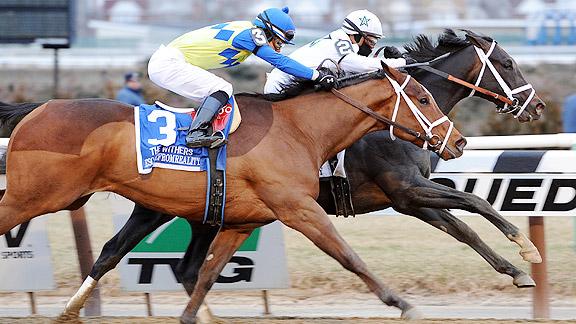
Revolutionary wins by a neck
in the Grade III Withers
Two outcomes reversed what was a relatively positive day for NJ Horseplayer, where I was among 230 players gunning for a Top 20 finish that would have put me into the SSC Invitational on April 20 (where the top 2 of 60 qualifiers will win a berth to the 2014 National Handicapping Championship):
  • an EXTREMELY questionable disqualification of one of my horses
  • Revolutionary's gutsy win in the Grade III Withers Stakes
Ahead of the contest where players could bet on any of the races carded at Aqueduct, Tampa Bay Downs and Gulfstream Park, I had handicapped the full Aqueduct card and the first 9 at Tampa, honing in on a few good opportunities early in the contest card.

Tug of War (4-1) was a flop in the opener at Aqueduct, but I hit on back-to-back prices in my next two:
  • $5 win-place on 8-to-1 Coffee Clique in the opener from Gulfstream
  • $10 win on 7-to-1 Blackeye Wynn in Race 2 from Tampa
Coffee Clique was a last-minute pick (hence my tepid $5 WP wager).

The race caught my eye because another horse entered, 3-to-1 morning line favorite Jadira, was one of my top picks...in a race on Tampa's card.  Jadira scratched from Tampa and ran here, and was bet down to 2-to-1.  At that short a price, I saw the value in Coffee Clique, ridden by Joe Rocco and trained by Brian Lynch, first time on grass and it paid off -- $18 to win and $7.80 to place, running my starting $100 bankroll to $144.50.

Blackeye Wynn, meanwhile, was one of my top picks, and in hindsight I could have been more aggressive with my wager, but the race went off right after Gulfstream 1 had ended, and so my reaction was slow.

The final odds might have been better had the field not scratched down to 8 from 10, but my horse made a lot of sense, considering the primary threat, even-money Late Developer, had never gone 7 furlongs and I thought might get snookered (and subsequently discouraged; it was an $8,000 claimer, after all) by cheap-speed long-shot I'am a Player.  The race went as planned, with Blackeye Wynn rushed to the lead by Huber Villa-Gomez winning by an uncontested length and paying $16.60 to win.

So, after 3 wagers, I more than doubled my bankroll to $217.50 -- near the artificial goal of $250 that I figured would be needed to make the Top 20 and SSC Invitational, but with lots of racing to go.  

Enter the Tampa Bay Downs Stewards...

Finding myself in a relative comfort zone, I revisited some capital preservation strategies discussed here almost exactly a year ago.  Rather than a full-bore show-bet mentality, however, I co-mingled lower-basis minimum ($10) wagers over a dozen more plays, but stuck to my prior-night's handicapping and notations on my past performances.

To: Tampa Stewards
From: NJ Horseplayer
The first was $5 win-place on long-shot Duty Blues (15-to-1 morning line) in Race 3 from Tampa, I considered a route horse at heart who was way over his head in prior overnight dirt stakes at Calder and 5-furlong grass sprints at Tampa.  I thought the horse would be overlooked (he was, going off at 18-to-1) stretching out to a mile, 40 yards on dirt, even in a middling 7-horse field at the $30,000 allowance condition.

Duty Blues outran all but 1 horse in the stretch to finish second (to 5-to-2 favorite Thank U Philippe), so if nothing else I was going to cash a $5 place wager on an 18-to-1 overlay, right?

Wrong!

In what I would consider one of the worst judgments I have seen, the stewards disqualified Duty Blues for supposedly interfering with a clearly fading fourth-place (also 18-to-1) Shellback in the stretch.

I have watched the replay at least a dozen times (here's the link) and remain baffled.  As I see it, Jose Lezcano came in with Thank U Philippe on MY horse, who maintained a straight line and was bumped inward by the winner near the finish.  To boot, you can see jockey Antonio Gallardo did all he could to keep Duty Blues straight, and when he did move inward, it was AFTER Shellback clearly began to fade (clear at the side angle).  Heck, in the head-on replay you can even see the tiring Shellback wanting to drift out with his head veering right.  Give Shellback jockey Scott Spieth an Academy Award, too, for pulling up his fading horse right before the wire.

Once Tampa publishes the Steward's Report I will post it here, but considering the ruling took more than 10 minutes to announce (and very confusingly, at that), I found the decision extremely fishy, as did fellow contest player Paul Zerbst, who had Duty Blues as well.  Heck, we both thought, if anything, the winner could have been disqualified and our horse moved up to first (not dropped to fourth)!

Perhaps we're biased, but I have seen far worse interference and no resultant D'Q.  I tweeted @TampaBayDownsFL on Saturday night about this, to no avail.  

Turning to Capital Preservation

The Duty Blues dissertation and D'Q aside, my focus remained firmly on the races ahead.

Originally, I planned to sit out from lackluster Aqueduct races 2-8, but with a $207.50 bankroll figured I would dabble in some show-wagering strategies.

Race 4 provided such an opportunity -- a 5-horse field with a prohibitive favorite in 1-to-4 Princess of Sylmar in the $100,000 Busher Stakes.

As bridge-jumpers were in on Princess in the show pool, I figured it was worth risking $10 in the event Princess stumbled or got a really bad trip and finished out of the top 3, but that did not happen.  My horse, second choice Kelli Got Frosty, finished second, for a virtual wash on my $10 show bet.  (The same scenario played out in Gulfstream Race 5, won by the impressive Verrazano at 1-to-9.)

I came up empty on $10W bets at Tampa, where both runners ran game seconds -- 4-to-1 Judge Well in Race 5 and 8-to-1 Kitten's Dumplings in Race 7. Sure, I could have gone conservative there by mingling in place or show bets, but at the same time I was within striking distance of cash prizes to the Top 10 contest finishers to entirely scrap win-only wagers.

My tenth contest wager, and the only one I'm really kicking myself about, was a somewhat impulsive $10 show wager on Isn't He Perfect in the Toboggan Stakes from Aqueduct  He ran disinterestedly under an impassive Irad Ortiz and finished 5th of 6; this was another race with sizable show money bet on the favorite, Johannesburg Smile, but my strategy backfired.  Still, my bankroll was $169.

Revolutionary Ride

The handwriting on the wall was becoming clearer to me after contest bet #11 -- a $5 win-show wager on 16-to-1 Escapefromreality, a Read the Footnotes 3-year-old who made a lot of sense to me as a possible upset play to 3-to-4 Revolutionary in the Grade III Withers Stakes from Aqueduct.  I went show instead of place again because the bridge-jumpers were out en masse for Revolutionary.  I figured that, in the odd chance that Revolutionary misfired, the show payout would have been grand.

On my PPs the night before, I made a note: "give long look @ 3."  

For background, Escapefromreality broke his maiden first out at Aqueduct in November and got beat by a neck in late-December in a $54,000 New York-bred allowance by Go Get The Basil, a next-out winner January 31 when stretching out first time around two turns (1 mile).  I speculated that Escapefromreality could do the same.


Too bad my race was a mile and a sixteenth (instead of just a mile).

Jose Ortiz gave Escapefromreality as good a trip as any, getting out of the gate without trouble and saving ground through the backstretch.  On the other hand, Revolutionary seemed to be having a hard time, trailing the field into the homestretch and stuck behind others along the rail.

Into the stretch, Ortiz moved Escapefromreality outside of two horses and appeared set for an upset...until Javier Castalleno, proving his expertise, patiently waited for an opening and exploded past Escapefromreality to win by a neck.

Talk About Deflated 

Instead of a $270-plus bankroll and pretty much a guaranteed spot in the SSC Invitational, I sat there stunned by Escapefromreality's defeat and frankly failed to respond, whittling down my $166.50 bankroll to a final $77.50 with some tepid plays and a skittish -- and failed -- $50 win wager in the finale that capped my afternoon.  Had I been confident in a particular horse in the finale (Tampa Race 12) I would have gone all in, but by that point I settled on a horse I found logical around 4-to-1 and bet enough to gave myself an outside shot at the Top 10 and almost certainly a necessary Top 20 finish, without zeroing out.

Monmouth Park has yet to validate the final standing for SSC#1, but I marked the winner down at slightly above a $1,000 bankroll, and 20th-place (good enough for the SSC Invitational) at $230.50.

It was not holding, coach
Building upon my $217.50 high watermark with strictly show wagers would not only have been boring, but perhaps fruitless on a day where big favorites largely prevailed.  Perhaps a conservative strategy would have done the trick, but I have no regrets on a day where my handicapping was strong (i.e. hitting 2 plausible long-shots back to back and cashing 4 show bets) and I had 4-5 near misses on others.

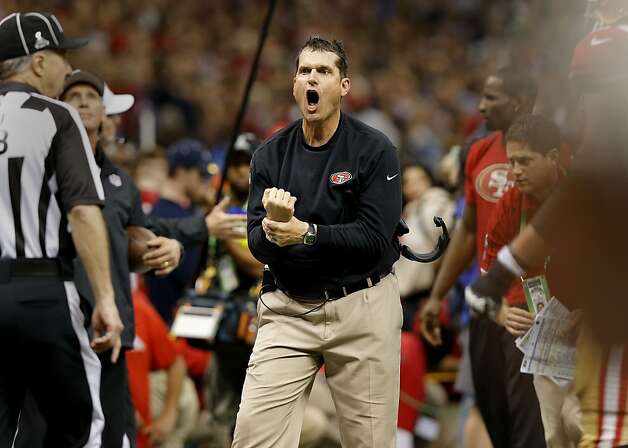
Not to turn Jim Harbaugh on everyone, whining about the officiating, but after three days of reflection, the Tampa Bay Downs third was an obvious momentum changer that proved difficult to ignore.

I can accept being beaten by what looks to be a Kentucky Derby contender, not by a subjective and questionable decision by three people behind the scenes.

Next up: SSC#2, Saturday, March 2.  I hope to be there...and see you there!


Tuesday, January 29, 2013

Quest for Jim Benes' NHC Crown Begins Saturday

Congrats to professional horseplayer Jim Benes of Illinois for winning the $750,000 top prize on Saturday as champion of the National Handicapping Championship (NHC)!

Not this Gunning for Glory...
but you get the idea
The margin of victory was scant for the second year in a row (Mike Beychok won NHC XIII by $1 of notional winnings), with Benes beating out NJ Horseplayer's fellow Garden Stater Roger Cettina, of nearby Rumson, by $1.20 on a chalky, but extremely lucrative, selection in the contest finale from Santa Anita.  Rich Grose, the leader after Friday's opening round, finished fourth.

Enough of the platitudes...time to gun for a spot in NHC XV and Benes' title as NHC champ!

The quest for me begins this Saturday with Simulcast Series Challenge #1 at Monmouth Park.

For the faint of cold winters, SSC (3 such $200 buy-in tourneys produce a 60-player "invitational" in April for 2 berths to NHC XV) is the perfect remedy.  The weather forecast here in Central NJ is tame, so there should be no threat of postponement on account of poor driving conditions.

The only conditions that matter will be those at Aqueduct, Gulfstream Park and Tampa Bay Downs -- the three tracks in play for SSC#1.

The contest parameters, for those who have never played in this event, are straightforward: $100 contest bankroll, mandatory 10 wagers on any of 10 races at the three tracks, and wagers on only 1 horse per race are only win, place and/or show of at least $10 each; failure to meet the parameters results in disqualification.

Players will pony up $200 -- $100 to a no-takeout pot split between the Top 10 finishers, and the other $100 for player bankrolls.  Thereafter, it's open game, as players can bet their $100 on any of the 30+ races carded, with an eye on finishing with the highest bankroll for the day...or, simply finishing in the Top 20. Note, too, that players keep any accrued winnings.

This year, Monmouth expanded the number of players in the SSC Invitational (Saturday, April 20) to 60 (from 45), which could change strategy of horseplayers like me who simply want to qualify for the Invitational.

Last year, the 15th-place finisher in SSC#1 finished with a meager $127.50 bankroll, though results of SSC#2 and SSC#3 suggest players this Saturday will safely qualify for the SSC Invitational by increase their $100 starting bankrolls to around $225-$250.

The question for me ahead of starting my handicapping on Friday becomes whether I can cast aside my mentality of going for the win (after all, first prize is estimated at $10,000 if 200 players enter), or be happy with, say, a 20th-place finish.  If I am lucky enough to hit enough races to increase my bankroll to $200, for instance, logic would suggest that a conservative stance would suffice. However, will other players in the same spot employ the same tactic, or will someone, say, in 21st place with a $190 bankroll sit on their winnings and hope others fall out of the Top 20, or go for broke with a large wager in the finale?

I suppose the solution is to build a $1,000 bankroll a third of the way through the card, but that is probably not realistic.  Nonetheless, I would expect other SSC#1 players to consider similar strategies as me, which is what makes the Simulcast Series Challenge not only a great remedy for the winter blahs, but an even more interesting mental exercise with 15 more total contestants eligible for the Invitational in April.

Saturday, January 26, 2013

Grose Advantage, But NHC XIV Wide Open

Missouri's Richard Grose leads the 14th Annual National Handicapping Championship in Las Vegas by nearly $67 heading into Saturday's closing day, but my first thought after reading the Daily Racing Form's recap is that the pressure's off all other contestants.

Players make 14 mythical $2 win-place wagers and 1 mythical $4 "best bet" win-place wager from a selection of 8 mandatory races and 7 "players choice" races (i.e. any of the tracks used in the contest).  I suspect that players will focus their 7 wild-card wagers on deeper-carded races at Gulfstream Park and Tampa Bay Downs, where a long-shot can be had, as opposed to a track like Golden Gate Fields (only 3 races with more than 7 horses) and Santa Anita, where rain is sure to result in scratches and solely dirt races.

From my limited history in competing in live handicapping contests, players usually win with a bankroll at least 10x the value of their starting bankroll.  So, assuming a $64 bankroll on Saturday for each player, figure that NHC XIV remains wide open as players roll the dice on horses at least 10-1 or more.  In online contests, the ratio tends to be less, since all races are mandatory and players can win betting chalk.

Nonetheless, my guess is that Mr. Grose's lead is anything but safe.  We'll soon find out...

Best of luck to all NHC XIV contestants and safe travels afterward!


Friday, January 25, 2013

Harnessing My Expectations

As 450 or so players vie for the National Handicapping Championship (NHC XIV) title that gets underway Friday (and Saturday), those of us on the sidelines are left chomping at the bit for a shot at the January 2014 NHC...or simply jealous that we failed to qualify for this year's Vegas extravaganza.

I'm not the jealous type, so I wish this year's NHC competitors nothing but the best.  It would be an achievement to someday qualify.  I figure it took last year's NHC champ, Michael Beychok (great speech at the Eclipse Awards, by the way), seven years just to qualify for NHC; perhaps my fate will be the same.

The 2013 NHC Tour schedule does not begin until February (in my case, with the first of three Simulcast Series Challenges).  Next Saturday at Monmouth Park cannot get here fast enough.
Translation: Bill's horses
will break stride

In the meantime, and somewhat on a lark, I played last Friday and Saturday in two free World Harness Handicapping Championship qualifiers on HorseTourneys.com.  I also signed on for two more contests this Friday and Saturday, but last week's grim performance does not augur well for any shot at the top spot, which would qualify me for the WHHC at the Meadowlands on April 13.

I put out a request for a Q&A with U.S. Trotting Association (USTA) communications director Dan Leary, but in the meantime I'll share my observations about harness racing.

One words come to mind: baffling.

I know so little about pacers and trotters that, even after my father explained the difference to me at least a half dozen times, I find the standard-bred world an entirely different animal than handicapping thoroughbreds and cannot distinguish between the horses' gaits, nor the past performances, rendering me clueless and, in all likelihood, with no shot at winning a spot in the WHHC.

Since it's been more like upper Saskatchewan here than New Jersey here in the Garden State the past few days, I figured I could cozy up under a blanket and practice my handicapping, albeit on a different breed of horse racing...figuring..."how different can it be, really?"

Immensely, would be my observation.

Consideration of the post position, trainer-jockey combos and class seem somewhat akin to thoroughbred handicapping, but concepts such as form, "cover flow" (race-caller parlance for drafting behind other horses, I suppose) and, especially, breaking are drastically different.

I suppose I could draw a thoroughbred sprinter's stumble out of the starting gate as a parallel to a trotter breaking stride after the start (i.e. galloping, rather than pacing), but really I dislike the concept that, with standard-breds, a horse is essentially cooked if he or she breaks.  To the contrary, I have seen thoroughbred sprinters recover from a bad start and still win or make a superfecta.

Case in point.  An acquaintance is part owner in a horse who raced at Dover Downs on Thursday night.  The horse was fresh off a win and seemed in a winnable spot, but in hindsight I learned that this horse looked askew in the warm-up and post parade and the owner knew the horse would run a clunker.  Sure enough, the horse broke stride just as the race started and finished dead last.  (Editor's note: I learned Friday afternoon that the horse chipped its hoof and should have scratched, but the trainer didn't.)

Without belaboring the point, and because I would rather first question an expert on the industry before tossing my curiosities about standard-bred racing totally aside, my initial observation is that fan education is a major problem for harness and thoroughbred racing alike.

HorsePlayerNow.com has been absolutely wonderful in trying to fill the void, and I suppose America's Best Racing deserves mention, though it seems to me a scaled-down HorsePlayerNow.com, but I have had trouble finding good resources on the harness game.  Maybe I'm just looking in the wrong places.

Sure, I printed the free past performances from HorseTourneys.com for last (and this) weekend's handicapping contests, but I might as well have read the Bible for hopes of Divine Intervention.  The marks for 2- and 3-wide "trips", for example, gave me no clues in prognosticating the contest races, nor about a horse's form or the jockey's tendencies.

I just find the thoroughbred PPs far more transparent, considering recent workouts, pace tendencies (i.e. front-runner, stalker or closer) and easier visually. Maybe it's more a comfort and experience issue for me.  Plus, features like the DRF Formulator let readers mine a boatload of data for more-granular data.  No offense to Trackmaster (here's tonight's contest races), but the horses' PPs are less telling, and the width of the jockey's bike (or sulky) often eliminates chances of horses (namely on half-mile tracks) winning from outside posts, which makes me question the value of past performances.

Maybe I'm being too harsh on the harness game and I'll shock the world in Friday's contest (featuring Chicago's Maywood Park) or Saturday's (Cal Expo, northern California), but I'm finding quickly that maybe I'm either a generation too late or simply not grasping the complexities of harness racing to draw my allegiance away from thoroughbreds.  We'll see.  Maybe that'll change.

Tuesday, January 15, 2013

Contest Paradise

I would never advocate buying five entries into any handicapping contest, but the price was too attractive for me to pass up five entries in small-stakes online contests run by HorseTourneys.com on Tuesday.

The National Handicapping Championship (NHC) hub, according to tourney director McKay Smith, recently implemented major systems upgrades to expand the site's capacities, and used a series of five free contests as a test run.  The winner of each would receive $50 in HorseTourneys.com site credit. 

All five contests (3 "pick-and-pray" format, 2 conventional) were open to HorseTourneys account holders and centered on races 2-7 from Turf Paradise. Ironically, all but one of the six races were on dirt, but one has to admit that "Turf Paradise" has a sexier ring than "Dirt Paradise" and most likely did for the track's founders.

"Horse Racing and Spinal Tap"
Ribbing aside, I noticed these tourneys over the weekend and hurriedly signed up, figuring that even in the middle of a workday I could handicap in advance and roll the dice, especially with no knowledge at all about Turf Paradise, outside of my friend Terry having visited the Phoenix, AZ track and providing me a visual akin to Atlantic City Race Course.

With five opportunities, and literally torn between five horses in Race 2, I played the contest like a Pick 5, going five deep with each of my cards featuring a different selection.  Thereafter, I generally went with my top selection for Races 3-7, since most of the contests were "pick-and-pray" (i.e. submit selections for all races before the first contest race goes off), though I fruitlessly dabbled with one ticket in real time.  

My strategy worked decently, as 3-to-1 morning line favorite Jacksonville went off at nearly 5-to-1 and produced a surprising $17.20 of win-place money to tie me atop one of the contests.  Unfortunately, my top selection, Mixed Intent, yielded grudgingly in deep stretch at nearly 10-to-1, a huge overlay from a 9-to-2 morning line; but at least I picked up $10.60 of place money on that ticket, so I was at least alive on two of my five contests. 

After finishing off the board in Race 3 (this one came back to bite me, as right before selections locked in I switched off the horse that ultimately finished second), my handicapping prowess shone through.  I hit on 3-to-2 (but second choice in the wagering) Surfliner in an easy Race 4 score to pad my bankroll by $8 and nearly got 9-to-1 Hometown Heart home in Race 5, but settled for $8.40 of place money. 

With two races to go, I was squarely in the Top 20 (of 150-200 contestants) on two of my five tickets, before vaulting into third place on my pick-and-pray ticket after Bear's Tigerette romped to an easy score in Race 6 to increase my bankroll by $9.20.  Granted, these were "move the chains-type" scores, contrary to my penchant for long-shots, but Surfliner and Tigerette were underlays; can't control the odds... 

In the final race, a $3,000 beaten claimer at 6 furlongs, I was tethered to 12-to-1 (morning line) Loco Marianna.  Based on the way she broke from the gate, however, I sense there was a typo in the program and the horse's name was actual Poco, and I knew my chances to score a $50 site credit were done.  My alternate selection (online contest players typically pick a "backup" horse in the event their main selection scratches) ran on for second, but the place money would not have been enough to vault me to victory.

The end result was pretty decent, considering that four of my five cards basically featured the same selections.  Out of as many as 200 contestants per contest, I finished as high as fourth-place and in the top 35 in three of the other four contests.  On the one ticket where I was able to still make changes in real time, I switched off my Race 4 and 6 winners and fished for big prices that never developed; so maybe it is best, after all, to stick with my original selections, regardless of the live odds.  

Now, would I or anyone in their right mind bet an 8-to-5 shot like a Surfliner early- or mid-card in, say, the upcoming Simulcast Series Challenge at Monmouth Park on February 2?  Probably not, as 7-to-2 is usually my "playable odds" threshold in live-money contests such as SSC.  

On the other hand, Tuesday's performance left me a little more confident in my handicapping ability in early 2014, and validated my view that winning (or at least placing near the top in) handicapping contests is much more than picking winners.  I picked 3-of-6 winners on Tuesday's contest card and logged a pretty lucrative place payout in another race, yet did no better than fourth place.  

Contests are about picking spots to make a plunge.  Moving toward SSC#1, I need to work on avoiding the urge to swing for the fences (as I did on my real-time card noted above) and key one or two viable, undervalued selections that could send me to NHC paradise in 2014.  

Sunday, January 6, 2013

"New" Quest for Vegas begins February 2

After a wonderful Christmas season and an excellent week-long family vacation in Punta Cana, Dominican Republic (save for 2 days bedridden with the flu), I accept the reality of a long, cold winter in New Jersey.

That, and for a second-straight season, my failure to qualify for the National Handicapping Championship.

Espanol still fresh in my mind
That's alright, though, as I clean the slate and note two dates on the calendar that already have my juices flowing -- February 12, when pitchers and catchers report for MLB spring training (we're big baseball fans in the NJ Horseplayer camp), and more importantly, Saturday, February 2, the start of the Simulcast Series Challenge (SSC) at Monmouth Park!

I may not have made it to Vegas for this year's $1.5 million NHC, but February 2 is but four weeks away, and the first of three SSC qualifiers at Monmouth.  The drive for Vegas begins then!

FYI -- SSC#2 is scheduled for Saturday, March 2, and SSC#3 for Saturday, March 30.

There's a slight difference in the format, whereby the Top 20 (up from 15) from each SSC qualifier will advance to the SSC Finals (April 20) for 2 seats to NHC XV in January 2014.

The increase in the number of players eligible for the SSC Invitational is certainly appealing, but with no increase in number of NHC prizes, reduces the odds of winning a spot in Vegas from 1-in-22.5 to 1-in-30.

Granted, I have a simple goal of merely qualifying for the Invitational for the first time ever, but I can only speculate that Monmouth's motivation for increasing the field size for the finals was either financial (i.e., to cover any higher fees that Monmouth Park must pay the NTRA to cover the cost of 2 NHC seats), or simply to raise the level of competition on April 20.

Whatever the motivation, adding 15 players to the SSC Invitational field gives me a better chance of at least making it to the Invitational, which will be one of my goals in 2014.  I hope to see you there!